Yippee, it is Bucking Horse day across on the Vacana. See if you can't recognise your students in this tale from the Buddha. Link
Showing posts with label musings. Show all posts
Showing posts with label musings. Show all posts
Monday, 2 June 2008

Monday, 14 April 2008
QoS wins
Despite all the talk from the Aberdeen fans in the office, I was surprised to read that the Dumfries team had actually won at the weekend. The Dons fans were on about the terrible game and how it was a waste of money ... I was under the impression that it had been a walkover for Aberdeen. But no. The underdogs win.
I don't follow football at all, but Queen of the South are from my home town, and also the only football game I have ever been to when I was young, so what the heck.
That means they are through to the finals of the Scottish Cup. Wow.
Match details from BBC site
PS: if anyone wants to console Sheila, feel free.
Monday, 10 March 2008
But I've Done This Before
As the cry of "I've done this before" goes up over the land on a Monday morning, the answer comes from Aristotle:
We are what we repeatedly do. Excellence, then, is not an act but a habit.
A colleague noted that no-one would pass a driving test after just changing gear once. We get better, faster, use it as a basis for new skills, type letters and manipulate graphics without having to think of how we do something. Repetition is, however, seen as boring. And boredom is the enemy of education these days. Was it always thus? I don't know. I find the world a place of infinite variety, infinite challenges, and the chance to make infinite mistakes. Sometimes I learn from them, sometimes I don't. Life is like that. Varied. Challenging. And only boring if you let it. I like the idea of strengthening the neural pathways by using games. The issue becomes taking skills from the virtual word, and bringing them back into the real world. Typing tutors are easy to transfer from the virtual to the real, but what about other skills?
In a world which relies heavily on computers, does dealing with avatars in a virtual world help you deal with a customer in the real world? Do they react the same? They don't, but are your reactions the same? Do they allow people to achieve excellence by repeating encounters in a controlled manner and allowing the learner to try out different strategies? Or will people just get more frustrated that the real world isn't the same as the virtual one?
What if the word processor made a "quack quack" noise with every spelling mistake? Turn the real world into the virtual. As much of our work is done on computers anyway, isn't it all virtual anyway?
Sunday, 24 February 2008
SpeedCabling
Perhaps we could run SpeedCabling competitions? Maybe a book-token for the winner?
A new "sport" based around unravelling the mass of wires that can typically be found beneath computer desks the world over is taking off in the western US.
The first "speedcabling" competition took place in an art gallery in Los Angeles and was won by LA-based web developer Matthew Howell.
The challenge was devised by IT professional Steven Schkolne. Contestants are faced with a tangled mass of six ethernet cables of various lengths. Their task is simply to separate them in the fastest time.
To get them to replicate the conditions of the wires found snaking and choking their way around hard drive units, monitors and printers in offices worldwide, Schkolne first started by tangling them in a figure eight. Then he threw the bundles in a clothes dryer - no longer attached to any computer unit, naturally.
Full story from BBC News
Saturday, 16 February 2008
That's Alright
Watched some of the "Elvis: '68 Comeback" dvd from June 1968. (trailer)
Just under 40 years ago. The youngest person in the audience looked to be around 10 years old. Some 50-, 60-, 70- year old folk are walking the streets, being pestered by thieves and wasters because they are old, but they have the knowledge that they experienced something unique. Something that the modern stolen, downloaded, processed music can't reproduce.
So; go and see live music when you can.
Will it be enough to save the Lemon Tree? Who knows, but you'll have the experience in your brain and no-one can take that away from you.
Tuesday, 12 February 2008
First of Many
Today I went to work in daylight, and left 10 hours later in daylight. I am sure that this is a first for 2008.
Monday, 4 February 2008
And The Clocks Were Striking Thirteen
It was a bright cold day in April, and the clocks were striking thirteen.
And so starts George Orwell's "1984".
On each landing, opposite the lift-shaft, the poster with the enormous face gazed from the wall. It was one of those pictures which are so contrived that the eyes follow you about when you move. BIG BROTHER IS WATCHING YOU, the caption beneath it ran.
Orwell was writing it exactly 60 years ago this year, and it was published in 1949.The book is as apt today as it was when I read it in 1984.
He had been appointed to a sub-committee of a sub-committee which had sprouted from one of the innumerable committees dealing with minor difficulties that arose in the compilation of the Eleventh Edition of the Newspeak Dictionary. They were engaged in producing something called an Interim Report, but what it was that they were reporting on he had never definitely found out. It was something to do with the question of whether commas should be placed inside brackets, or outside.
Following links from Wikipedia, there are copies from Australia and cartoon versions, even a radio play from 1949. I must re-read it before April this year. There was a good series on BBC2 recently about British Science Fiction. I think it came originally from BBC4. I used to read a lot of early sci-fi when I was travelling to/from school on the bus, but I think it was American early and "golden years" stories. Unlike tv programmes and fleeting media, I find that reading things stays more in my brain. But I'm sure that's just a sign of my age. But then again, what's the point in remembering tv programmes if you can't give a copy of the documentary to a mate - but you can point them to a book, or a film. We are losing information into the aether of marginal tv channels where the makers can generate extra revenue in the hope that we, the public, will follow. If the data is out there and we can't find it, then it might as well not exist and we should call the fire brigade.
There was a whole chain of separate departments dealing with proletarian literature, music, drama, and entertainment generally. Here were produced rubbishy newspapers containing almost nothing except sport, crime and astrology, sensational five-cent novelettes, films oozing with sex, and sentimental songs which were composed entirely by mechanical means
If you've never read the book, go to the library and get it. Go to a bookshop and buy it (maybe even from one of these cheap shops or charity shops). Or read the linked file text from Wikipedia. You won't regret it. Or you can get back to your entertainment, being happily advertised as "brain-dead tv".
Sunday, 3 February 2008
Cross-fertilisation
Cross-fertilisation.
I noticed with interest that "Live for the outdoors" (Trail/Country Walking) have an advert in a photography magazine (Digital Photo, March 08). It's not great, as it isn't tailored to that market especially, and the graphic used is badly pixilated....but, in the same way that Bob's TOS allowed him to move away from 'just' being sticky content for BPL.co.uk, so this rebranding allows L4dO them to market their online content to people who are interested in the outdoors, but not the magazines.
As this involves a lot of user-generated content, I wonder how people who participate in it feel about being 'used' in this manner. No doubt, so long as there are still meets and competitions, and a feeling of community, they are happy that the hosting of photos, and cross-fertilisation of ideas and gaining of new ones is worth it. Of course, as magazine sales drop in favour of online content, one also wonders how long it will take before revenue generation becomes a bigger part of online companies. The usual way of doing this is to have basic (free) access, and additional (subscription) content. Just look at BPL.com for this model.
The fight is on, not for you to buy their magazine, but for them to get you going to their one-stop-shop for all your <insert interest here> needs. If you take photographs of the outdoors, go to <insert name of site> and you'll find content that you can customise to give you the information that you want and need. Of course, there'll be advertising tailored to this, but it will not be spam, because you might find some of it interesting.
The hunt is on. The customer is the prey. You can always switch off, escape from it all, but you'd better not go near a digital media service of any sort. Artificial intelligence and marketing. All for your benefit. Just don't eat the soylent green.
Monday, 21 January 2008
Sunday, 23 December 2007
Citizen What?
From 13th November 2007:
The National Union for Journalists (NUJ) has admitted its first full-time freelance professional blogger as a member.
Conrad Quilty-Harper, who blogs for technology blog Engadget, had his application for membership approved at a meeting of the NUJ’s London Freelance branch last night, Tim Gopsill, editor of The Journalist, confirmed to Journalism.co.uk.
Harper was invited to attend the freelance meeting where his application was passed after he was initially rejected by the union for being a student on a non-media course.
And earlier, on the 25th October 2007:
Guardian media blogger and former Daily Mirror editor Roy Greenslade is quitting the National Union of Journalists (NUJ), because of the organisation's attitude towards new media.
Greenslade, who has been a member of the union for 42 years, announced his resignation on his blog and said it would be 'hypocritical' to remain a NUJ member 'when I am now so opposed to the union's central aims'.
In his post Greenslade said the group's policies needed to be updated to accommodate the growth of online journalism: "Journalistic skills are not entirely wiped out in an online world, but…they cannot be confined any longer to an exclusive élite group."
Explaining his decision Greenslade suggested that while the NUJ sees the internet as a threat to journalism 'it [the web] is much more a threat to the union itself.'
"[T]he union, as with the print unions of old, cannot possibly adapt to meet the revolutionary demands of a new technology," his blog post said.
Interesting times indeed. Anyone fancy a Diet of Worms? In the same way that professional photographers have been affected by sites like Flickr, cheap dSLRs and people willing to put the time and effort in to try and improve their skills, then journalism must also be affected. It comes to reason, that as news becomes more speculative, exclusives are not exclusives, the tv news complains when people rebroadcast their feeds but happily show YouTube videos without stating that they have the owner's permission. What really separates the paid journalist from the citizen journalist? Time, effort, money, resources, skills in obtaining the news, a talent for language. Some have skills and talent, others one or the other - just like in any job. Is every citizen a journalist? No. Is everyone who owns a camera a photographer? No. In days past, eyewitnesses to events would only be able to describe the event, now they have videos and still photos, some have been keeping blogs instead of written diaries.
In a knowledge-lead society, do we need to be able to distinguish between facts and opinions. Is a review in a magazine opinion or fact? Are comments left about a piece of software factual or trite nonsense left by a competitor? Only the knowledgeable reader can judge. But where do they learn that judgement from? No-one seems to be teaching online citizenship these days.
"First they ignore you, then they laugh at you, then they fight you, then you win." Mahatma Gandhi (source)
Are bloggers looking for a fight? I amn't. What is victory? I don't know. Anyone can use the same quote when they feel that they are being oppressed. Do I feel that bloggers are being oppressed? Wise up. Blogs are merely a medium. The person behind the computer is the important cog in the Web2.0 wheel. In our own mind, we are important. We are important to our families and friends. We matter. Does what we have to say about the world matter? Probably not. But we are social animals, we have brains and can think. So why not use the tools available to us to be sociable, to think and to converse. Geography, social class, skin colour, cultural background, age, gender, physical abilities and religion are less important than your ability to be a sentient human being. If you refuse to think, to reason, to discuss, to create, then you are an empty shell of a being.
Maybe that is what scares some in the media? A lot is just boring, brainless drivel, re-hashing old news, cutting back on investing in investigative journalism, and making decent programmes for television. If there is only so much happening in the world, but news has to be available 24 hours a day, 7 days a week, why can't there be more detailed, in-depth news? Maybe because we, the recipient, have no time for it? In the Information Age, there is a growing divide - the news reflects this. There are just too many channels for their to be a good standard of quality programmes. Will this change in the future? I don't know, but can guess that there will be an increase in the number of niche channels.
For the record, my main sources of news are: BBC News website, Radio 4's Today programme, Radio 4 news (especially midnight), Newsnight, Channel 4 news.
Wednesday, 19 December 2007
Why Blog? Why?
Why are we blogging? I've previously covered the "How", so here is the "why". Why? Blogs are simply a format for creating a mini-website. This website allows you,the blogger, to write about things, to post photographs, videos, music that you have created, things that have caught your interest. It is your online presence.
If social networking sites just allow people to see what music you are listening to, films you've seen and the like, then that is similar to someone looking at your house. They see the physical side of you, but not you yourself. Blogging allows you to put your feelings out there, to show that you are a sentient human being, with hopes and expectations, good times and bad. You can write about what you see, what you feel about books you have read, or movies you have seen.
The empathy that writing about personal issues (but not too personal) allows people to be people. Instead of looking at the possessions, you can get a better idea of what the person is like.
With forums, chatrooms, and other community communications services, you can interact with other people. It is like a park for people with similar attitudes. With blogs, you can leave comments, and ask the person questions, or answer their questions. It is like a chill-out space. Less noise.
Everything in a blog is customisable, so the blogger has more control over what the reader sees. This allows more control that you get in most other mediums. You have little control over the appearance of forums, as they are community affairs. You post what you post, and you take responsibility for it. You are a 'citizen journalist', rather than one part of a commune.
The blog format allows many types of media to be incorporated, and the list is growing. This allows even more of your personality to come through. If you are bad with writing words, then use photographs or music instead. Communication is the important issue. You have a story to tell, and you need to find a way to communicate that to others. Whether that story is a small story - a bus that is always late - or a big story - being arrested by the police - someone else may be interested. Even if no-one is, you can always look back at your own blog and see what you were thinking at the time you wrote it.
Blogs are timed pieces of your life. They show what you were like at that moment. Isn't that priceless?
This was going to be a piece about the future of blogging, and the advantages of RSS feeds instead of the reader having to search for information, but I couldn't be bothered with that. If you want to see these things for yourself, look here:
Tuesday, 27 November 2007
Monday, 26 November 2007
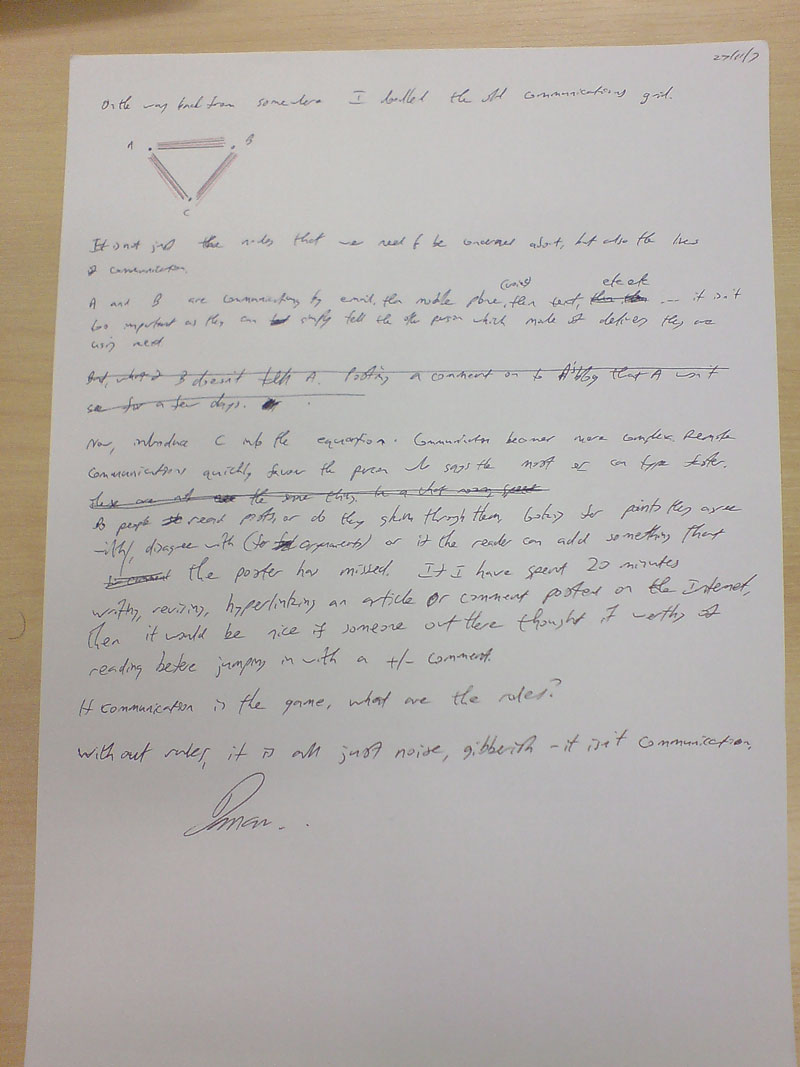
How I Blog
The technicalities are usually set out by the communications device:
1. Windows Live Writer from computer. A great free program. Even allows me to download, amend and repost articles. Eg adding better photographs than the ones sent from the mobile phone.
2. Blogger editor online if computer I'm using doesn't have WLW. I find this clunky, as I like opening linked articles in a new window, and Blogger's editor doesn't allow me to do this, unless I go through adding target="_blank" code.
3. Mobile phone - blogging when walking or travelling. I use the email facility, rather than the built-in blog software. If the blog post doesn't connect, I can't send another post, but a failed email will just sit in the outbox.
Topic - generally this comes first. What have I to say? George Orwell wrote about the four great motives for writing, and I think every post can easily fit into at least one of those categories:
(i) Sheer egoism. Desire to seem clever, to be talked about, to be remembered after death, to get your own back on the grown-ups who snubbed you in childhood, etc., etc.
(ii) Aesthetic enthusiasm. Perception of beauty in the external world, or, on the other hand, in words and their right arrangement. Pleasure in the impact of one sound on another, in the firmness of good prose or the rhythm of a good story. Desire to share an experience which one feels is valuable and ought not to be missed.
(iii) Historical impulse. Desire to see things as they are, to find out true facts and store them up for the use of posterity.
(iv) Political purpose. Using the word ‘political’ in the widest possible sense. Desire to push the world in a certain direction, to alter other peoples’ idea of the kind of society that they should strive after.
For me, I don't tend to bother about (i) or (iii). I like the idea of doing something first, showing photographs of areas that others may not have seen, pushing the new media of blogs a bit further than they were before - I think that is a category (iv). And most of the rest are (ii) - aesthetic.
In less prosaic terms, the types of blog articles that I post are either:
1. Input - reposting information that has come in from elsewhere, e.g. news items, articles from forums, weather, what was first communicated in a non-Web medium e.g. tv/radio/podcast/book/magazine, site statistics.
2. Processing - taking information and forming new ideas from it.
3. Output - sharing an event or thought that I have experienced.
4. Feedback - I rarely revisit old posts, old journeys.
Once I have the general idea for the post, I start writing. Well, sometimes it takes me a while if it is a "processing" article. The recent article on Convergence 2.0 took me a couple of days to formulate in my brain - aided by some cold walks, when my brain needs to think to keep working. It often gives me time to come up with a snappy title.
I used to use random titles, taken from the music track that I had been listening too. Nowadays, I find it difficult to locate articles written back then.
I also used to post a day's-worth of articles in one post. Again, I find it difficult to locate articles written back then.
My posts tend to be reasonably well cross-referenced. This gets round one problem with communications, where people from different cultures don't have the same terms of reference. So, talking about "Dad's Army" may get UK readers thinking of the old BBC comedy, but others around the world may not have a clue. Using Wikipedia or YouTube helps greatly.
Most "processing" posts then to have a beginning, middle and end. They are formed articles. Sometimes the "output" posts fall into this system too, but often they are linear, telling the reader about what happened at the start, middle and end of a journey.
Most "input" articles are brief and to the point. Sometimes very short indeed. Much depends on my mood and the amount of time I have available.
In conclusion
I blog using the best hardware/software available to me at that moment. I tend to write about different things. I often go back and change posts, adding in more links, better photographs or fixing mistakes.
If you are not blogging about what you are experiencing, or sharing information or adding your visions to the human consciousness - then what the heck are you doing in the 'Sphere, dude?
Thursday, 15 November 2007
Convergence 2.0
Yesterday I watched Alan Yentob's "Imagine...WWW" with a couple of HNC classes, as he covered the future of the Web. Although a year old, I was surprised to find a couple of items from it being cited that day:
- David Firth, of SaladFingers fame, was on ScreenWipe last night on BBC2. (Sorry Salima).
- "The Long Tail" being discussed on the new http://twit.tv/natn podcast. (YouTube video)
To me, this reflects the power of Web2.0. It is about sharing ideas, just-in-time learning, and creativity. A real meritocracy. Participate or not, it is your choice, just don't complain about missing out. Learn Japanese if you want. Learn how to create spheres in Photoshop if you want. Learn how to fold a lightcube if you want.
Leo and Amber described themselves as being Internet Content Creators. Not being pigeon-holed into one particular format. I thought back to the Yentob programme, where he mentioned convergence. The two ideas, memes if you will, merged, intertwingled. I had been thinking of convergence in a Web 1.0 way: the technologies coming together so that, for example, my mobile phone has a media player, so I don't need two devices. What if I think of convergence in a Web 2.0 way? The sharing, the communities, the people, the learning, the exploration, the fun, and the meritocracy is all that is important, and not the hosting technology.
Do I care that you are listening to this on a podcast? Nope. Do I care if you are using Safari on a Mac, or browsing via a mobile phone? Nope. So why should you care if this is posted on a blog, written on a forum or a wiki, in some class notes or discussed in a YouTube video. Is this not what converging technologies should be really about? Share the knowledge, share the creativity, share the power. In return you will gain new knowledge, find new creativity, and be empowered to take new strides forward.
Any media that fails to keep up has a problem. Any technology that fails to keep up has a problem. But that is their problem, and not ours.
Glory is fleeting, but obscurity is forever said Napoleon.
Do we not want our futures to be glorious? The revolution has started. Your future jobs will be affected by the new uses, the new systems, the new convergence. Software and hardware are just the tools of the trade. In the past, a joiner would use a variety of saws, chisels, and the like - today you use a variety of ICT tools to complete the job. Fall asleep, and the world keeps on moving without you. Miss work, and you need to catch up. The days of the dinosaurs are coming to an end. The new world is fast-moving, fun, slender and dangerous for dinosaurs.

If you don't understand something, ask, delve into the meme pool, visit the library; look for ideas from the past, from other technologies, merge concepts together. Stand on the shoulder of giants. There are only 26 letters in the English language, but that didn't stop William Shakespeare or Terence Alan Patrick Sean Milligan, so why should it stop you? There are fewer chords than that and even less primary colours, so why should these restrict you from being a better artist or musician?
The main restrictions are time, quality and money. Much software is legally free. Quality improves as you invest more time, or more money to buy hardware or better software. Time is the problem. You can do anything, you just haven't the time to do everything.
Wednesday, 14 November 2007
OD Oh
Before leaving work tonight, some of us were chatting about "Heroes", and it got me thinking as I (finally) left the office in the cold and dark...
- Maggie - she had seen series 1 on Sky. Her son had seen part of series 2 abroad.
- Duncan - had seen next week's on Freeview, but would be recording the terrestrial showing of it tonight as the Freeview picture isn't great quality. So the 0900pm showing was a 'repeat'. Wasn't sure if I'd be watching the next show on Freeview when it came on. [I decided that I'd better as "0.07%" was gripping].
- Doreen - seen some, but lost her place. Would like to borrow the series when I've finished recording it.
So my brain, in an attempt to keep warm, starts thinking thus...We all watch the same TV series, but we can't discuss it openly without the fear of dropping a spoiler. Is "on demand" stopping the promotion of television programmes? Is it making us more insular in our watching habits? Is too much choice watering down television? If you are constantly switching channels, does it become easier to just switch off?
Old College Project
When people whinge and moan about having to do work at College, just take a moment to consider the fact that you came to College to get the skills and qualifications to get a better job. Out in the real world, you'll be up against people who really want that job. If you grudgingly answer questions asked, slouch in the chair and show a general lack of indifference, you won't get the job, and you'll have to come up with some excuse as to how it wasn't your fault you didn't get the job. Then you'll shrug, and say that you didn't want the job in the first place.
Or you get real, and wise up. Here is one of former student, Mark Stirton's old college projects:
Put this level of effort into your work; show interest, show flair, show passion for your career. Interview panels can detect this quickly. They can also detect laziness, disinterest and lack of willing. Guess what? So can we. Good luck for the future.
Friday, 9 November 2007
Frozen windscreens
I'm having a Totoro morning. Can't get the song out of my head. Passed a chap clearing frozen snow from his car windscreen. A light dusting of same can be seen in gardens.
Thursday, 8 November 2007
Permission to blog, sir?
I'm still a novice with photographing people. I get nervous when asking there permission unless i know them. So you won't see a photo of the squaddies in the information cabin outside M&S playing bowling on their Wii. One was wearing a sniper's ghillie suit.
Wednesday, 31 October 2007
Youth Music
Many of the problems of today's society may be down to the fact that modern kids tv programs don't have decent theme songs. The songs we carry through life enter our heads from an early age. I'm not talking about the actual program, but the music.
Examples:
My childhood "The Flashing Blades"; "The Banana Splits".
Current childhood "Spongebob", "Watch my Chops".
Simplistic, maybe, but what happy sounds do you retreat to when life gets hectic? It might explain the recent popularity of The Hoosiers.
Subscribe to:
Posts (Atom)